
Light tower knowledge · 01
What a night of light
actually costs.
Fuel burn per hour, litres per night, and the bill at three diesel prices — measured against the four towers we build. Plus what a solar tower has to beat before it pays for itself.
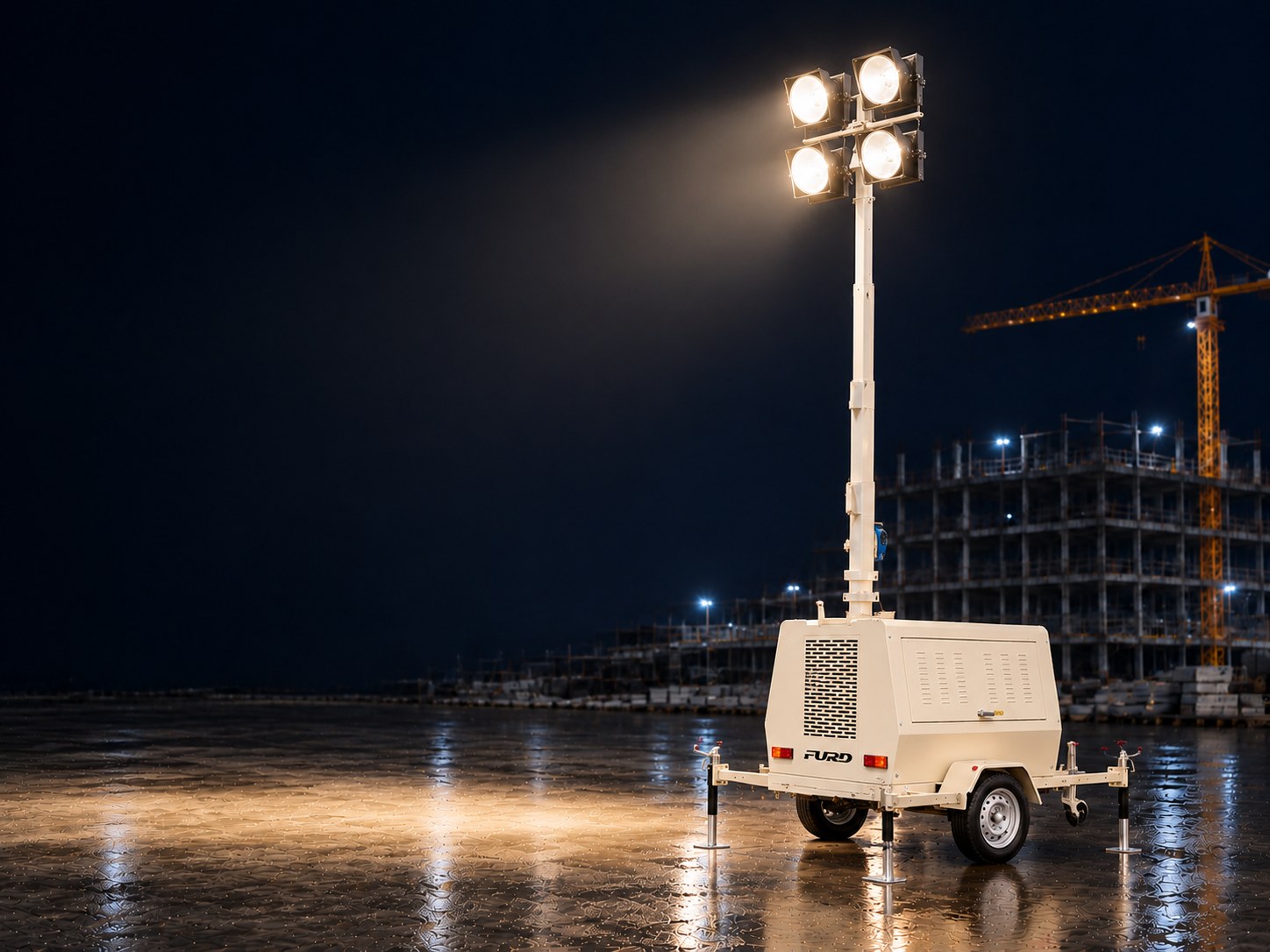
A 9 m tower with four 1,000 W metal-halide lamps burns about 1.9 litres of diesel an hour — roughly 19 litres for a ten-hour night. The same mast with 400 W LED heads uses about 1.1 litres an hour.
LED cuts fuel by about 45%, not the 60% the lamp wattage alone suggests: a small diesel running at a quarter load is at its least efficient. A solar tower burns nothing at all — its running cost is the battery pack, counted in cycles.
01 — The bill
The four numbers that set the bill
Every quotation we send carries a fuel figure, and that figure comes from four things you can check yourself. None of them is a trade secret, and none of them is fixed — which is why two contractors on the same site can run the same tower at very different cost per night.
- Lamp wattage. Four 1,000 W metal-halide heads draw 4,000 W. Four 400 W LED heads draw 1,600 W for a comparable spread of light. This is the first and largest lever, and the one most easily measured on a spec sheet.
- Engine rating against the load it actually carries. An 8.4 kW engine pushing 5 kW of load uses less fuel per hour than the same engine pushing 7 kW — but more fuel per kilowatt-hour. That distinction is the whole of section 03.
- Hours of darkness you work. A ten-hour night in Nairobi in June, a twelve-hour night in Johannesburg in July and a six-hour tropical night are three different costs from the same tank.
- The price of diesel where the tower stands. Pump price is not the number that matters. Delivered price to a site 200 km from a refinery, in drums, is.
The first three you decide once, at purchase. The fourth moves every month and is usually the largest single line in the running cost of a diesel tower — that is what the cost table below varies.
02 — One night
One night, four towers
The figures below are for a ten-hour night, at the engine load each lamp set actually creates. Tank sizes are the ones on the specification pages, not rounded up for the article.
| Tower | Lamps | Tank | L / hour | L / 10 h | Nights / tank |
|---|---|---|---|---|---|
| FZMDTC-1000B9 m hydraulic · Quanchai 8.4 kW | 4 × 1,000 W metal halide | 100 L | 1.9 | 19 | 5 |
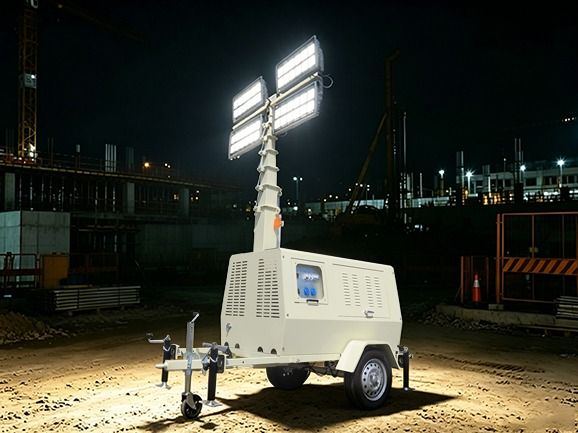
| FZMDTC-1000B9 m hydraulic, LED · Quanchai 8.4 kW | 4 × 400 W LED | 100 L | 1.1 | 11 | 9 |
| FZMTC-1000B7 m manual · Kubota Z482 4.8 kW | 4 × 400 W LED | 80 L | 0.9 | 9 | 8 |
| FZM-1000B5 m hand-push · KOOP 4.5 kW | 4 × 400 W LED | 12.5 L | 0.9 | 9 | 1.4 |
| FZMT-S16009 m manual · 1.6 kW PV, no engine | 4 × 200 W LED | — | 0 | 0 | — |
The 5 m hand-push column is the one that surprises people. Nine litres a night sounds modest until you notice it is a 12.5 litre tank: that unit is refuelled every shift, by hand, on site. On a month-long job that is thirty refuels and a drum to keep on the trailer — a labour cost the fuel price does not show.
03 — The counter-intuitive part
Why the LED tower does not halve the fuel
Four thousand watts of metal halide falls to sixteen hundred watts of LED. Multiply that ratio by the fuel figure and you would expect a 60% saving. We measure about 45%. The gap is the engine.
A diesel engine does not use fuel in proportion to the light it makes. It uses fuel in proportion to the work it does, plus a fixed amount just to keep turning. Close to rated load, a small industrial diesel consumes roughly 280 g of fuel per kilowatt-hour. At a quarter load — where an LED tower sits — the same engine needs 380 to 420 g/kWh, because the fixed losses are being spread over less useful work.
The 0.85 is alternator and controller efficiency; the 300 W covers fans, the controller and the mast electrics. SFC is specific fuel consumption in grams per kilowatt-hour, and 840 is the gram weight of a litre of diesel.
Run both towers through it. The metal-halide unit loads its 8.4 kW engine to about 5.1 kW — 61% of rating — and burns 1.9 L/h. The LED unit loads the same engine to about 2.2 kW — 26% of rating — and burns 1.1 L/h. The lamps lost 60% of their draw; the engine lost half of its useful work; the fuel bill lost 45%.
04 — The bill
What that costs at three diesel prices
Taxes, freight and drum handling move diesel a long way from the pump price. Rather than guess your market, here is the same night at three delivered prices. Take the column closest to your site and multiply by the nights you run.
| Tower | at $0.80 / L | at $1.20 / L | at $1.60 / L |
|---|---|---|---|
| FZMDTC-1000B 9 m, metal halide | 15.20 | 22.80 | 30.40 |
| FZMDTC-1000B 9 m, LED | 8.80 | 13.20 | 17.60 |
| FZMTC-1000B 7 m, Kubota | 7.20 | 10.80 | 14.40 |
| FZM-1000B 5 m hand-push | 7.20 | 10.80 | 14.40 |
Over a hundred nights — one wet season on a single site — the metal-halide 9 m tower costs between $1,520 and $3,040 in fuel. The LED version of the same tower, same mast, same engine, costs $880 to $1,760. The difference is not the lamps. It is the engine load the lamps create.
05 — Solar
Solar: no fuel, still a cost
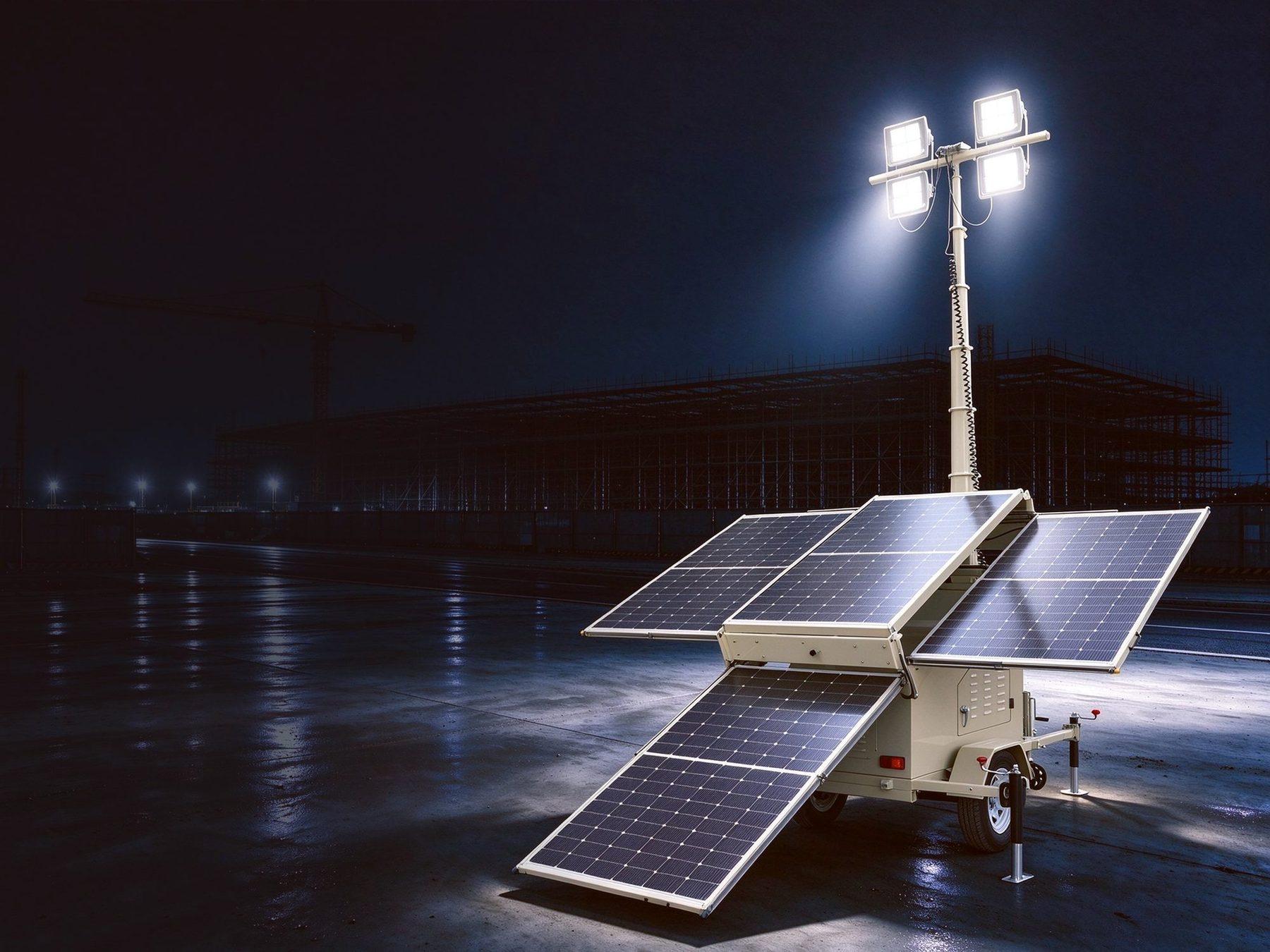
The FZMT-S1600 carries four 200 W LED heads — 800 W total — and a 1.6 kW fold-out PV array charging a 12 V battery bank. There is no fuel line on its running cost sheet. There are three others.
- The battery pack. It is the consumable. Every night draws it down and every day has to put the energy back; the pack has a finite number of cycles. Divide the replacement price by the cycle count and you have a cost per night that behaves exactly like fuel — it just arrives every few years instead of every morning.
- The array has to be able to keep up. An 800 W lamp set running ten hours needs about 8 kWh out of the pack, and the array has to replace it in one day. On a 5-hour sun day, 1.6 kW of PV returns roughly 7 to 8 kWh. That puts a ten-hour full-output night at the edge of what the array can recharge. Most sites either run six to eight hours at full output or drop to a two-lamp setting — and that is a planning decision, not a defect.
- Cleaning and siting. Dust on the panels is a straight percentage off the charge. So is a mast shadow at the wrong hour, or a truck parked alongside. Budget a wipe-down every few days on a dusty site, and keep the array clear.
06 — The decision
Which one to order
Neither technology wins everywhere. In our experience the split is predictable enough to put on one screen.
Diesel still wins when
- You need 4,000 W of light on a 9 m mast. Metal halide at that output is still the cheapest way to flood a large pour, and the LED equivalent at 1,600 W covers less area.
- The job is short. Under about a month, the fuel bill never gets large enough to justify the price gap on a solar tower.
- You are working a winter at high latitude, or a site that is dust-hazed or overcast for weeks. The array is sized for sun, not for a forecast.
- The site already has a diesel tank, a fitter and a fuel run. Marginal cost of diesel is then very low, whatever the pump price says.
Solar wins when
- The job runs for months, and the same tower sits in the same place night after night.
- Fuel logistics are the real cost: drums trucked 300 km, siphoning overnight, a guard on the tank. Solar removes that entire line.
- You need 800 W to 1,600 W of light, not 4,000 W — roadworks, gates, camps, car parks.
- There is a noise curfew, or the neighbours are residents rather than a quarry.
07 — The arithmetic
The payback arithmetic
Solar costs more to buy and less to run. Payback is the gap divided by the nightly saving, and it is worth doing the division before you argue about either price.
Worked on the 9 m LED tower at $1.20 a litre: $13.20 a night. If the solar equivalent costs $8,000 more, that is 606 nights — under two years of continuous night work, and less if diesel is dearer than $1.20 where you are. At $1.60 the same gap closes in 455 nights. At $0.80 it takes 910, and most buyers stay with diesel.
Two things this sum leaves out, and both push toward solar: the refuelling labour (one man, one vehicle, every shift) and the risk of the tank being emptied by someone else. If either is a real line in your budget, add it to the nightly saving before you divide.
08 — Questions
Questions we get asked
How much diesel does a light tower use per night?
Between 9 and 19 litres for a ten-hour night across our range. The 9 m metal-halide tower at 4,000 W burns about 19 litres; the LED towers at 1,600 W burn about 9 to 11 litres depending on which engine they carry.
Is a solar light tower cheaper to run than diesel?
It burns no fuel, so the running cost is the battery pack divided by its cycle count, plus panel cleaning. Whether that comes out cheaper overall depends on the delivered diesel price where you work and how many nights you run per year — the payback arithmetic above is the honest way to answer it for your site.
How many nights will a FURD tower run on one tank?
Five nights on the 9 m metal-halide tower from its 100 litre tank; nine nights on the 9 m LED from the same tank; eight on the 7 m Kubota from 80 litres; and about one and a half shifts on the 5 m hand-push, which is refuelled daily by design.
Do cold nights change these figures?
Yes, in both directions. Below about 5 °C the fuel needs a winter grade, the battery gives up capacity, and if you specify engine pre-heat the load goes up. We list the cold-climate build options on the model sheet — ask for them if the site sits above 1,500 m or works through a winter.
Can a metal-halide tower be converted to LED?
Yes, on the same mast and wiring. The ballast comes out, the load on the engine falls from about 5 kW to about 2 kW, and the fuel figure drops to roughly 1.1 L/h. Send the model code and we will confirm the lamp set and mounting for that mast height.
Want the calculation sheet
for your own site?
Send us the hours you work, the diesel price delivered to site and the area you need lit. We will send the model, the lamp layout and the same fuel arithmetic on paper — and the bench test sheet for the unit we would build.
- Fuel figures are engineering calculations from the engine rating, lamp load and the specific consumption curve of small industrial diesels — not bench measurements of a single unit. The test sheet for the unit you buy comes with the quotation.
- Directive 2006/42/EC on machinery, EUR-Lex — the directive our CE marking is declared against.
- LED lighting, U.S. Department of Energy — efficacy and rated life, for the lamp comparison.
- Commodity markets, World Bank — a public reference for diesel price movements if you want a second opinion on the delivered price you are paying.