
Light tower knowledge · 04
What a mine, a lane closure
and an event actually order.
The same four-lamp tower gets specified six different ways depending on where it stands. Here are the configurations that cover most of the briefs that reach us, and the one or two options that make the difference on each type of site.
Mines take the 9 m hydraulic mast with metal halide and a dust kit. Lane closures take the 7 m Kubota, or the solar tower where there are neighbours. Pours and hire fleets take the 9 m hydraulic with LED. Events and unmanned compounds take the solar tower, sometimes with a camera mast.
Everything else is an option on one of those four: a rear-lift mast, a bigger head, a radiator package for hot climates, a silent canopy for a 5 m hand-push.
01 — The map
The map: six sites, six builds
| Site | Model | Mast | Why this one |
|---|---|---|---|
| Mining, quarry, stockpile | FZMDTC-1000B | 9 m hydraulic | Area, height over berms, output that survives dust |
| Roadworks, lane closure | FZMTC-1000B | 7 m manual | Fast set, low tow weight, quiet Kubota |
| Night pour, tower crane | FZMDTC-1000B-LED | 9 m hydraulic | No restart gap, white light, low fuel |
| Hire fleet | FZMDTC-1000B-LED | 9 m hydraulic | One SKU, one fuel card, one set of spares |
| Event, camp, compound | FZMT-S1600 | 9 m manual | Silent, no exhaust, no fuel run |
| Remote pipeline, no fuel | FZMT-S1600 | 9 m manual | Independent of the diesel supply chain |
02 — Mining
Mining and quarry
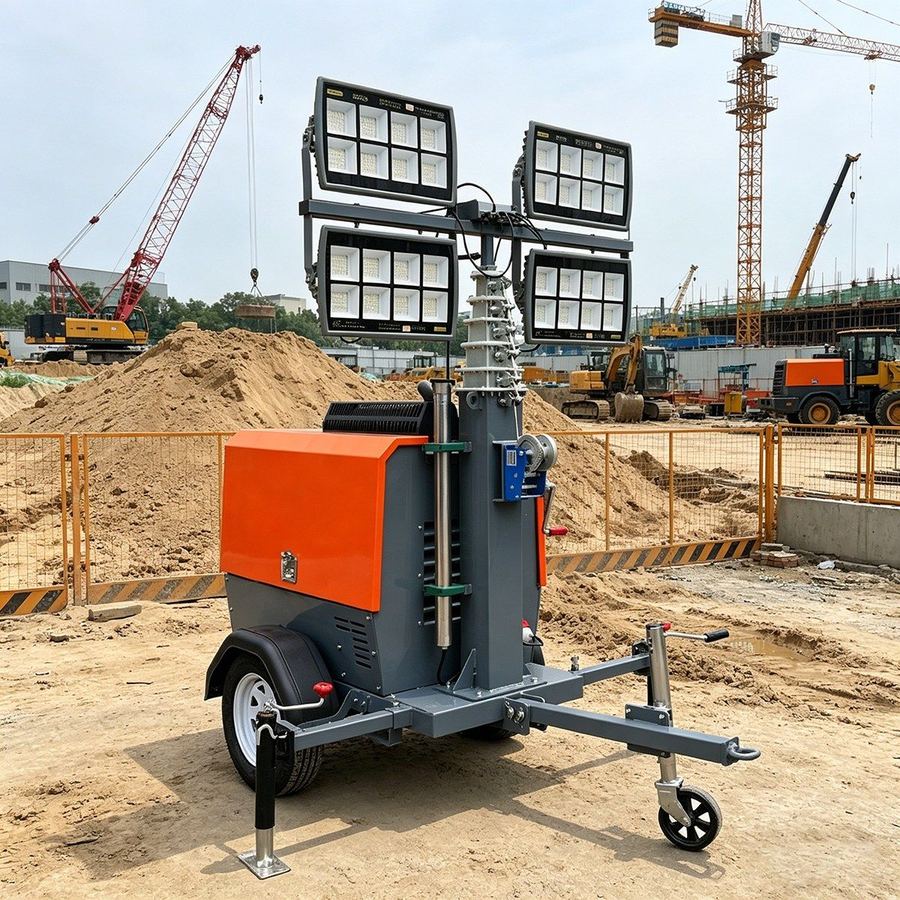
The requirement here is not lux on a drawing, it is area lit from one position. Faces are wide, stockpiles are tall, and the tower usually stands where it can see the working area rather than next to it. That is a 9 m mast with the biggest head set: four 1,000 W metal-halide lamps, hydraulic lift, 1,000 kg on the trailer so it does not walk in wind.
Three options carry the load on these sites. A dust kit over the engine and control panel, because a quarry in dry weather eats air filters. A radiator package for sites that run through 45 °C afternoons — the engine derates long before the lamps notice. And hydraulic rather than manual lift, because nobody raises a 9 m mast by hand twice a shift on a bench that is being blasted.
Stabilisers need something to bite. On graded hardstand they are fine; on loose stockpile shoulders we ask for pads or a steel plate under each foot, and the mast comes down if the wind gets up, whatever the duty rating says.
03 — Roads
Roadworks and lane closures
Road sites are the opposite problem: small area, short duration, moved often, and usually somebody nearby who did not ask for a night shift. The 7 m Kubota unit is what most contractors settle on — 420 kg, 4 × 400 W LED, Kubota Z482, quiet enough to stand at the edge of a residential street without an argument.
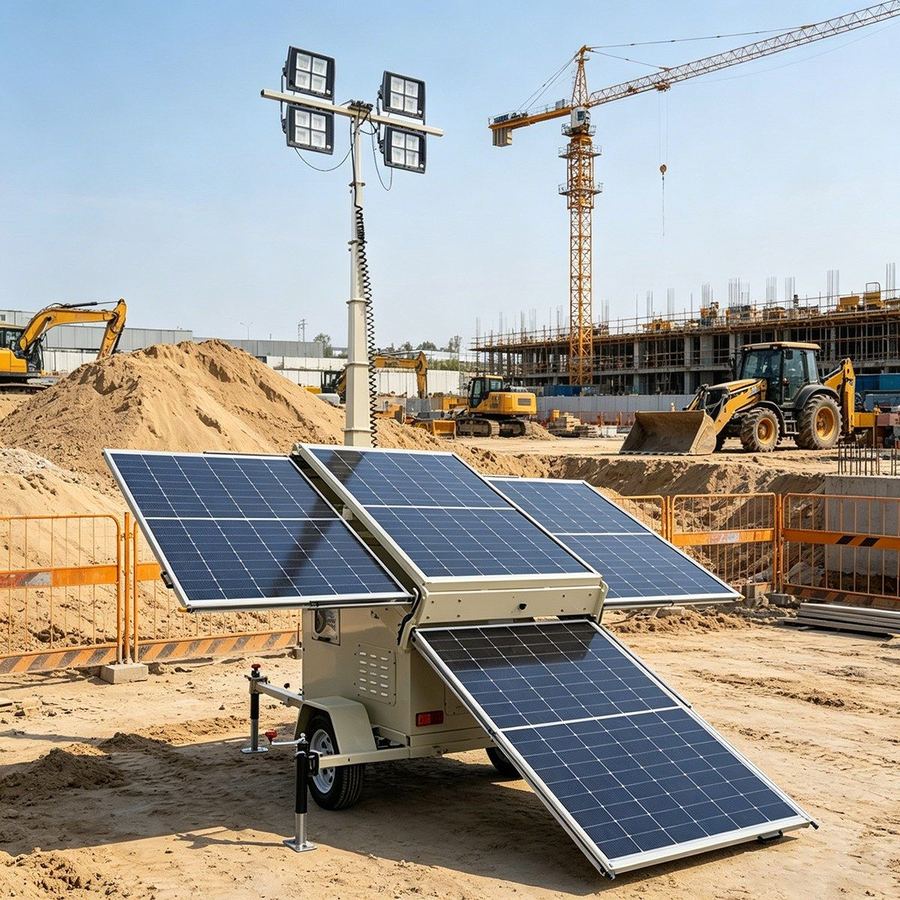
Where even that is too much noise, or where there is no fuel bowser within reach, the solar tower does the job: 800 W of LED off a 1.6 kW fold-out array, no engine running at all. Its limit is honest and worth saying out loud — it lights a working face and a walkway, not a motorway lane. For a full lane width at motorway lighting levels, diesel is still the answer.
Positioning matters more than the model. Keep the heads off the sightline of approaching drivers, aim the outer pair down at the work face rather than across the carriageway, and set the unit behind the coning so nobody has to walk into the live lane to refuel it.
04 — Pours
Pours, yards and hire fleets
A night pour is a lighting problem with a schedule attached: the concrete does not wait while lamps restrike. That single fact pushes most pour work to 9 m hydraulic with LED — white light for reading formwork and rebar, no restart gap if the supply is interrupted, and 1.1 litres an hour instead of 1.9.
Hire fleets converge on the same unit for a different reason: one SKU means one set of spares, one fuel card, one briefing for every operator, and a customer who cannot tell you which model they want will accept the standard one. The rear-lift mast option exists for yards that load and unload with a forklift rather than a ramp.
05 — Events
Events, camps and unmanned compounds
Here the constraint is not light, it is presence: no engine idling next to a marquee at 2 a.m., no diesel drum behind the toilets, no exhaust plume in a dust-free area. The solar tower covers it — 9 m manual mast, 4 × 200 W LED, 1.6 kW of fold-out PV and a battery bank that charges itself through the day.
The same build turns up in security roles: an unmanned compound, a site gate, a pump station. The camera variant adds a mast-top position for a CCTV head and a power take-off for the recorder, so the tower lights the yard and watches it.
06 — Differences
What actually changes between them
Strip the marketing away and the differences between these builds are five items: mast height and lift type, head set, mounting, climate options, and how the unit is moved. Every configuration on this page is a combination of those five.
| Variable | Options we build | Moved by |
|---|---|---|
| Mast | 5 m, 7 m, 9 m · manual or hydraulic · rear-lift | Site shape, loading method |
| Head set | 4 × 400 W LED · 4 × 1,000 W MH · 4 × 200 W solar LED | Required lux, restart tolerance |
| Mounting | Trailer · hand-push · canopy variants | How far it moves, how often |
| Climate | Dust kit · radiator package · silent canopy | Dust, heat, noise limits |
| Power | Quanchai · Kubota · KOOP · PV + battery | Fuel supply, service network, emissions rules |
07 — Questions
Questions we get asked
Can one tower cover a whole site so I do not move it?
Sometimes. A 9 m tower covers roughly 30 m of diameter at wide distribution, so one unit handles most compounds and many small quarries. If the site is longer than it is wide — a pipeline, a road, a rail corridor — two smaller towers beat one large one almost every time.
Which build suits a hot, dusty site?
The 9 m hydraulic with the dust kit and the radiator package. Dust affects the engine long before it affects the light: air and fuel filtration decide whether the unit keeps its output through a dry season.
Is the solar tower enough for a night shift on a road?
For a footway, a work face and a walkway, yes. For a full lane at motorway lighting levels, no — 800 W of LED will not do what 1,600 W or 4,000 W does. Be honest with yourself about which of those two the job is, because the solar tower is very good at the first and cannot do the second.
Do you build a unit that satisfies a specific spec or client standard?
Yes, within the same mast and platform. Send the specification — lux levels, mounting, emissions stage, colour, guarding — and we will say which parts we can meet and which we would have to change the platform for.
Tell us what the site is,
we will name the build.
One paragraph is enough: what has to be lit, how often it moves, who is nearby and what tows it. We answer with a model code, an option list and a price.
- Configurations and options are from our own build list; weights, masts and engine ratings are the figures on each model page and will be confirmed on the quotation.
- Coverage figures assume wide distribution and open ground — see the mast and lamp guide for the geometry behind them.
- Regulation (EU) 2016/1628, EUR-Lex — engine emission stages for non-road mobile machinery, relevant if the site is inside the EU or the buyer writes the clause.