
Light tower knowledge · 05
What fails, what you fix
and what to keep on the trailer.
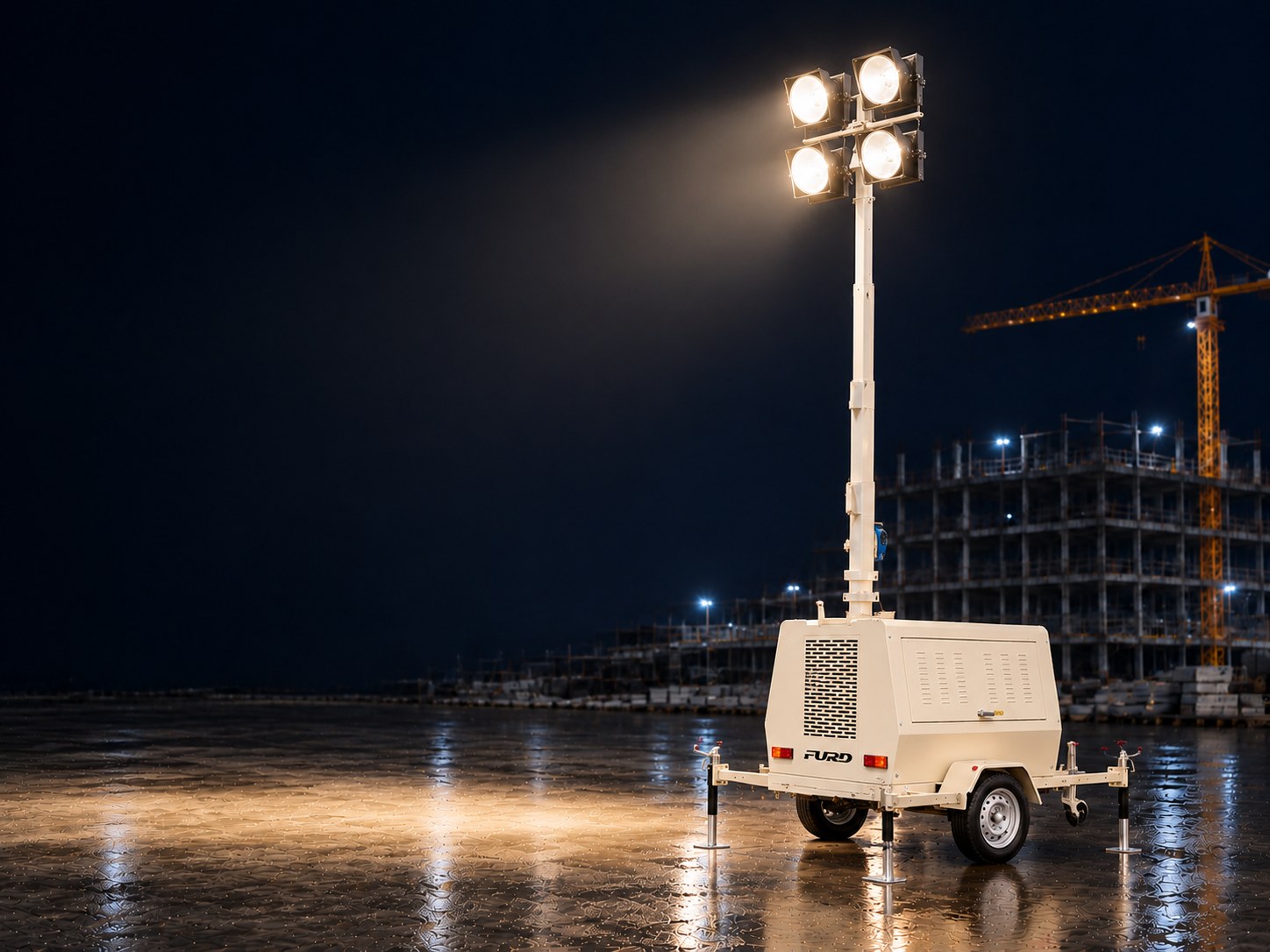
A light tower is not a complicated machine, but it has five parts that decide whether it works tonight. Here is what each one needs, which failures we see most, and the spares list we would put in the toolbox of any unit running more than a few nights a month.
Lamps, mast cable, the lift mechanism, the engine fuel system and — on a solar unit — the battery. Almost every dead tower we are asked about is one of those five.
Keep one spare lamp set, one ballast, one mast cable and a fuel filter on the unit and you can fix the two failures that stop a shift. The rest is scheduled service, and the schedule is the engine maker's, not ours.
01 — Failure modes
The five things that stop a tower
We ask every customer who reports a dead unit the same question first: does the engine start? It splits the list in two, and the answer usually points at one of these five.
- Lamps or ballast. A metal-halide lamp that has reached its rated life will strike, run for a few minutes, then drop out. Ballast failure looks the same from outside.
- Mast cable. The one failure that is a safety issue rather than an inconvenience. Insulation cracks where the cable runs over the mast sections, and a chafed live conductor against a steel mast is how a tower becomes dangerous.
- Lift mechanism. Winch brake on a manual mast, hydraulic seals and hand pump on a 9 m.
- Fuel system. Water or dirt in the tank, a blocked filter, a lift pump that has been run dry. Diesel that has sat for a season is the most common cause.
- Battery and controller on a solar unit — capacity lost to age, or a charge controller that has been left on the wrong setting after a battery swap.
02 — Lamps
Lamps and ballasts
On our metal-halide towers the wiring runs outside the mast, so a lamp can be changed on site without stripping the cross-arm or dropping the mast — a detail worth asking about on any tower you buy, because the alternative turns a ten-minute job into a two-person job at height.
Practical rules: change lamps in sets of four if they were installed together, because a mixed set drifts in colour and output; keep the old ones as emergency spares rather than binning them; and never touch a lamp with bare fingers — the oil film etches the quartz and shortens its life.
LED head sets do not have that lamp-life problem at all, which is most of the reason their service cost is lower. What they do have is a driver inside each head; if one head goes dark while the other three are fine, that is the driver, not the array.
03 — Mast
The mast: winch, cable and hydraulics
Manual masts live or die on the winch brake. Keep it dry, keep the cable spooled evenly, and do not let anyone use the mast as a step. Hydraulic masts live or die on seals and clean oil: a 9 m mast that creeps down overnight is telling you the seals are going, and it will not get better with use.
Inspect the cable on a schedule rather than when it breaks — look for chafe where it passes each mast section, and for flattening that means a strand has gone. Replace it as a cable, not as a repair.
Two habits that prevent most mast damage: mast down at the end of every shift on an exposed site, and stabilisers down and pinned before the mast goes up. A tower on its wheels with the mast raised is a lever, and wind is patient.
04 — Engine
Engine service
The service schedule is the engine manufacturer's, and we pass it on with the unit rather than inventing our own. What matters on a light tower specifically is that the engine spends its life at low load, which is exactly the regime that makes oil contamination and bore glazing worse — so the interval matters more than it would on a machine working at rated load.
- Oil and filter on the maker's hours, not on the calendar — and sooner in a dusty environment.
- Air filter is the single most neglected item on a quarry unit. Check it weekly in dry weather; a restricted filter costs fuel long before it stops the engine.
- Fuel filter and water trap — drain the trap weekly. Most "the tower will not start" calls are water in the diesel.
- Run it loaded for half an hour now and then. An engine that only ever idles at quarter load will glaze its bores and start burning oil.
05 — Solar
Solar: the battery is the consumable
A solar tower has no engine service at all, and that is worth real money on a remote site. What it has instead is a battery bank with a finite cycle life, and that is the running cost you are pre-paying. Cycle life depends on how deep you discharge it, how hot it gets and how well the controller is set.
Practical rules: keep the state of charge above the level the controller is configured for, do not park the unit in shade and expect the same output, clean the panels — dust on a PV array costs output exactly the way a blocked air filter costs fuel — and when you replace the bank, set the controller to the new chemistry rather than leaving the old profile in place.
06 — Kit
The spares kit
| Item | Quantity | Covers |
|---|---|---|
| Lamp, matching set | 4 (metal halide) | End-of-life lamp drop-out |
| Ballast | 1 | Dead lamp that is not the lamp |
| Mast cable | 1 length | Chafe, and the safety inspection |
| Fuel filter + water trap | 2 | Dirty or wet diesel |
| Air filter | 1 | Dust |
| Engine oil | 1 service | Top-up and the interval |
| Hydraulic seal kit | 1 | Mast creep on a 9 m |
| Fuses and a spare controller | set | Electrical faults, solar units |
That kit costs a fraction of a lost shift and fits in the toolbox of a pickup. On a hire fleet it is the difference between a unit going back out tomorrow and a unit going back to the yard.
07 — Seasons
Dust, heat, cold and salt
Dust is an engine problem first: filtration, cooling stack cleanliness, and the canopy seals. Heat derates the engine before it affects the lamps — a radiator package is cheaper than a replacement engine. Cold costs battery capacity, needs a winter fuel grade and, if you specify it, engine pre-heat. Salt air on a coastal site is a paint-and-fastener problem: wash the trailer, keep the stabiliser threads greased, and expect to replace hardware before you replace panels.
08 — Questions
Questions we get asked
How often should lamps be replaced?
On the rated life of the lamp — roughly 6,000 to 12,000 hours for metal halide — or when a lamp starts dropping out after a few minutes of running. If the tower runs ten hours a night, that is a lamp set every two to three years of steady work.
Can a lamp be changed without lowering the mast?
On our metal-halide towers, yes: the wiring runs outside the mast and the lamps sit on the cross-arm. On LED head sets the whole head is a unit, so the swap is a connector and four bolts.
How long does a solar battery last?
It depends on depth of discharge, ambient temperature and cycle count far more than on the calendar. A bank kept at shallow discharge in a mild climate lasts several times longer than the same bank cycled hard in a hot one. Treat it as a consumable and budget for its replacement from the start.
Do you supply parts after delivery?
Yes — lamps, ballasts, cables, filters and seal kits ship from stock, and we keep the build record for each unit so the right part is picked. Tell us the model code and the year on the plate.
Want the service sheet
for the unit you run?
Send the model code and the hours on the machine. We will send the engine service schedule, the parts list and the spares kit we would put on it.
- Service intervals follow the engine manufacturer's schedule, supplied with each unit; the notes here are what we find matters on light towers specifically, at low load and in dust.
- Lamp and battery life figures are typical published ranges for the components we fit, not guarantees — they move with duty cycle, temperature and site conditions.
- LED lighting, U.S. Department of Energy — rated life and lumen maintenance.